What is Biomechanics?
Biomechanics for birth is something most antenatal courses skip, even though it’s one of the most practical things you can learn to support your body during pregnancy and in labour.
At its heart, biomechanics is about supporting your body’s natural design, by improving balance and creating space + movement in your pelvis. When you understand how your pelvis, muscles and ligaments are connected, and how your body and baby work together, you can support physiology, help your labour to progress and potentially reduce the need for intervention.
Many midwives haven’t been trained in biomechanics, but that is slowly changing as more and more research comes out. It can be an absolute gamechanger for birth, so I’m excited you’re reading about it now too!
The pelvis your baby needs to move through
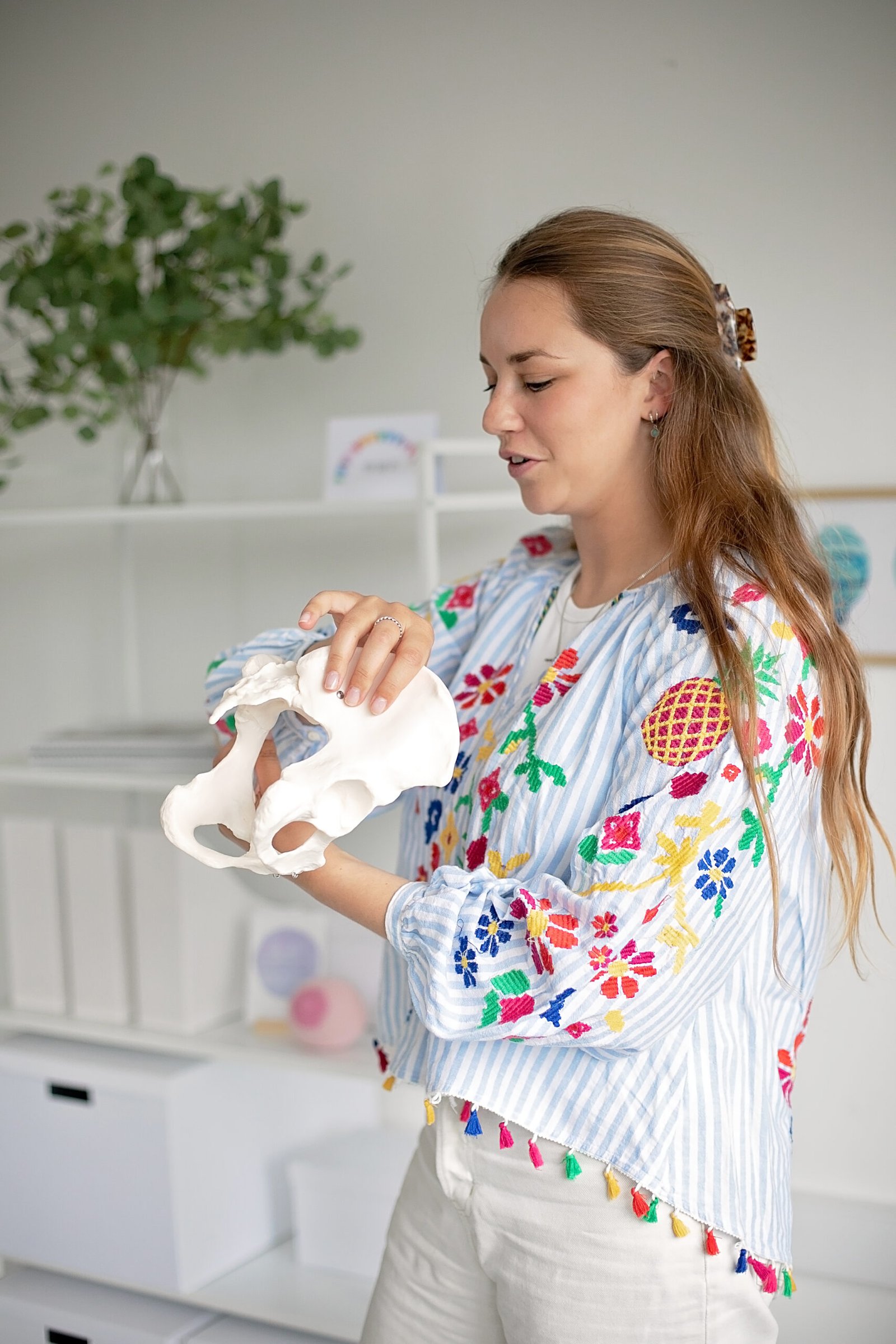
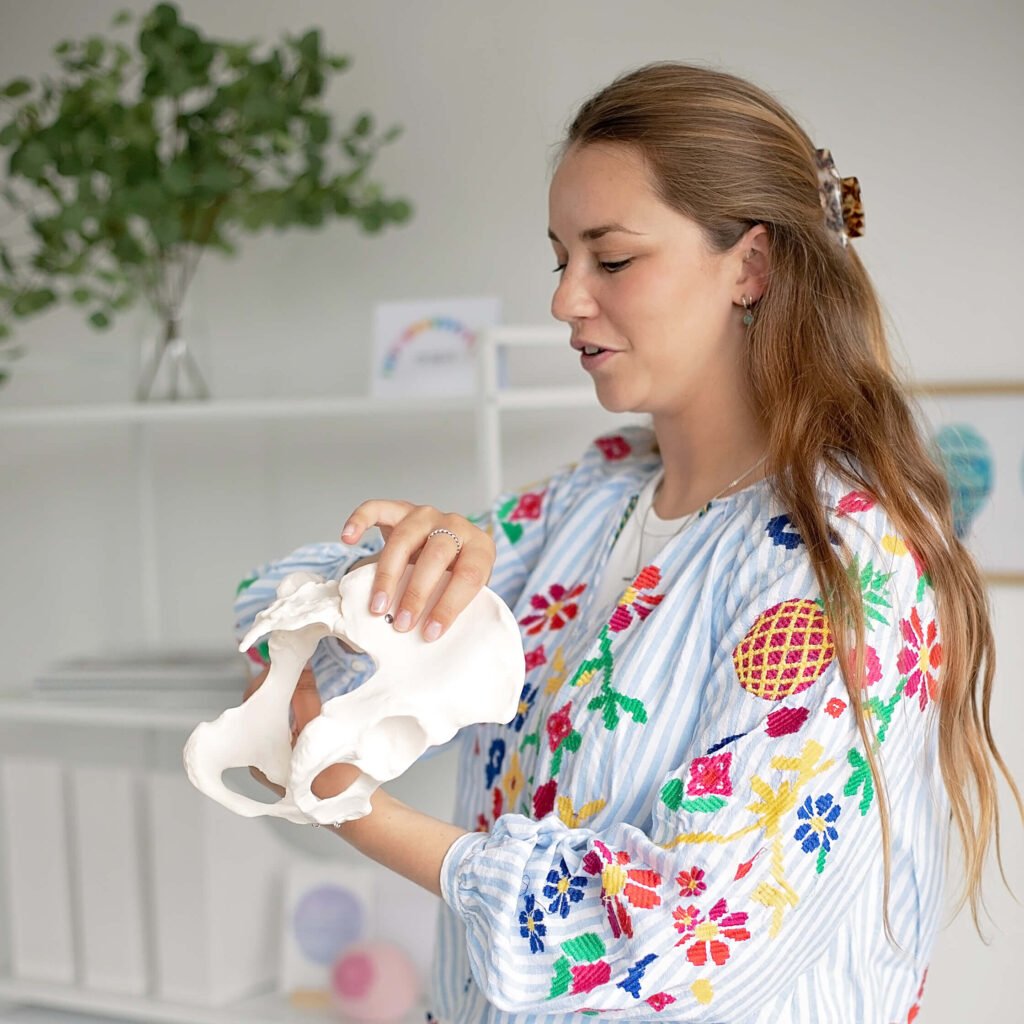
When we think about a pelvis, most of us picture a solid ring of bone. In fact, it’s several bones joined together by lots of joints + ligaments, and surrounded by muscles. Birth is not meant to happen with us lying on our backs, remaining still. The pelvis is designed to move!
In pregnancy, your body releases hormones, including relaxin, that soften those ligaments so the joints can shift a little more than usual, creating extra space for your baby to move through – amazing right! But, if some of the muscles and ligaments around the pelvis are tight, they can limit how far it opens and adjusts.
That’s where biomechanics comes in. Simple, targeted movements help to ease that tension and bring more balance and alignment to the pelvis, so there’s more room for your baby to move, rotate, and settle where they need to be.
Where does pelvic tension come from?
Think about your typical day. You might sit at a desk, then in the car, then on the sofa in the evening. You probably stand with your weight on one leg while you’re making a cuppa. If you’ve got a little one, they almost certainly sit on the same hip every time, and most of us sleep on the same side every night without even thinking about it. We all tend to have a dominant side.
None of these things are a problem on their own, but repeat them for months and years, and your body slowly adapts. Some muscles and ligaments end up shorter and tighter, while others work a bit harder to compensate. If one side ends up tighter than the other, it can put everythng slightly ‘off balance’ and your baby will adopt a position based on this.
A good way to explain this is: Imagine putting up a tent and pulling the guide ropes on one side much tighter than the other. Consequently the tent would be slightly wonky. The same thing happens to your uterus. It can be pulled tighter to one side meaning your baby could be more likely to settle in a less optimal position for birth – perhaps with their head on its side, and their chin not tucked in, because that’s most comfortable for them, but this would probably not be the most ideal position for birth.
So how does biomechanics help?
Biomechanics works in three main ways:
Easing tension. The muscles, ligaments and connective tissue around your pelvis can hold on tightly and limit how freely your pelvis moves. Gentle, targeted techniques help those areas soften and let go, so the whole pelvis can move more easily and evenly. Many women find these movements feel really soothing too, which is a lovely bonus. Easing tension is important throughout pregnancy, and also for labour.
Creating space. Your baby doesn’t travel in a straight line through the pelvis. They turn and rotate as they move through helping them navigate the shape of the pelvis. Think of trying to get a big sofa through a narrow hallway with a sharp corner at the end. It isn’t only about size, it’s about the angle and having room to turn. Opening up space at the top, middle and bottom of the pelvis gives your baby more freedom to adjust as they go. Sometimes a small change in how you’re positioned can make a surprisingly big difference.
Supporting physiological birth. When your pelvis is balanced and your baby has room to settle into a good position, your uterus, pelvis and baby are working together far more smoothly. Contractions can then do their job more effectively, because everything is lined up. In other words, biomechanics isn’t overriding what your body does naturally. It’s helping it work as well as it can.
What difference can biomechanics make?
A few benefits:
- It can help labour keep progressing. Not every labour that appears to have stalled or ‘slow progress’ is down to the effectiveness of contractions, although often this is where the blame is placed, and in some cases a drip of synthetic oxytocin is started. In fact, sometimes the baby is at an awkward angle or the pelvis is tight, and labour stalls/slows because of this. Addressing these issues can help get labour progressing again.
- It can ease discomfort. If your baby is in a less optimal position, you may feel constant pressure, pain or discomfort in your lower back, or on one side. This could be a sign your baby is malpositioned, so using various biomechanic techniques can create more space and movement in your pelvis supporting your baby to find their way into a better position, easing discomfort.
- It can support your baby’s position. Some babies settle into positions that make labour trickier, like facing your back or lying slightly to one side. Biomechanics isn’t about forcing a baby to move, but it can give them the space to find their own way into a better position.
- It may help reduce the need for intervention. If labour is moving along more smoothly, there may be less chance of needing things like induction, a drip to speed things up, or assisted birth because of a long labour. The research here is still growing, so biomechanics isn’t a 100% magic fix, however if your birth is becoming more medicalised or there are signs that intervention might be needed, knowing some practical biomechanics techniques to try is a good thing to have in your toolkit to support physiology.
- It’s great for pregnancy too: Practising and doing biomechanics techniques throughout your third trimester is beneficial too. Gentle movements in pregnancy can help ease tension and discomfort and encourage your body to stay balanced, so you’re better prepared before labour even begins.
Let’s support physiology
Biomechanics is a gentle, practical approach that respects the way birth works and the physiological process. It’s a set of simple tools, to be used at different stages of pregnancy and labour, that help your body do what it was built to do.
Every pelvis is different. Every baby is different. Every birth is different. Babies adopt all sort of positions, and so bimechanics should only be used in labour IF there are signs of malposition or a dystocia – I cover the signs to look out for in detail in The Biomechanics Toolkit Course. Biomechanics techniques are not needed all the time, as routine.
An example of this would be, if you get told your baby is back-to-back, which ‘on paper’ would be described as a less optimal position. Yet many women birth their babies in this position, because that was obviously best for their babies – nature is very clever at knowing what’s best, even if we don’t fully understand why.
So, if your labour is progressing smoothly, just listen to your body, and continue as you are (even if you find out your baby is back-to-back, for example). Learning about biomechanics is more about understanding your body, noticing what feels good (and when things don’t), and having a toolkit of practical options if and when you need them.
Biomechanics for labour works alongside everything else that supports a positive birth: like your mindset, your environment, the people supporting you, and having a real understanding of your options and how to get the best out of the modern maternity system. This is why my birth prep course, The Birth Toolkit, is a beautiful blend of antenatal education, hypnobirhting and biomechanics (practical technique videos being added very soon!). I truly believe you need all three to prepare for your birth in the best way possible. You can’t just rely on hypnobirthing tools and techniques, on knowiing the stages of labour, or on knowing the best positions for birth or your baby, because birth rarely happens like a textbook. You need to know how to use this knowledge in real life, know how to adapt to changes of plan and still feel in control of your experience, and this is where my midwifery expertise and support comes in, and it’s all inside The Birth Toolkit.
Find out more about The Birth Toolkit here.